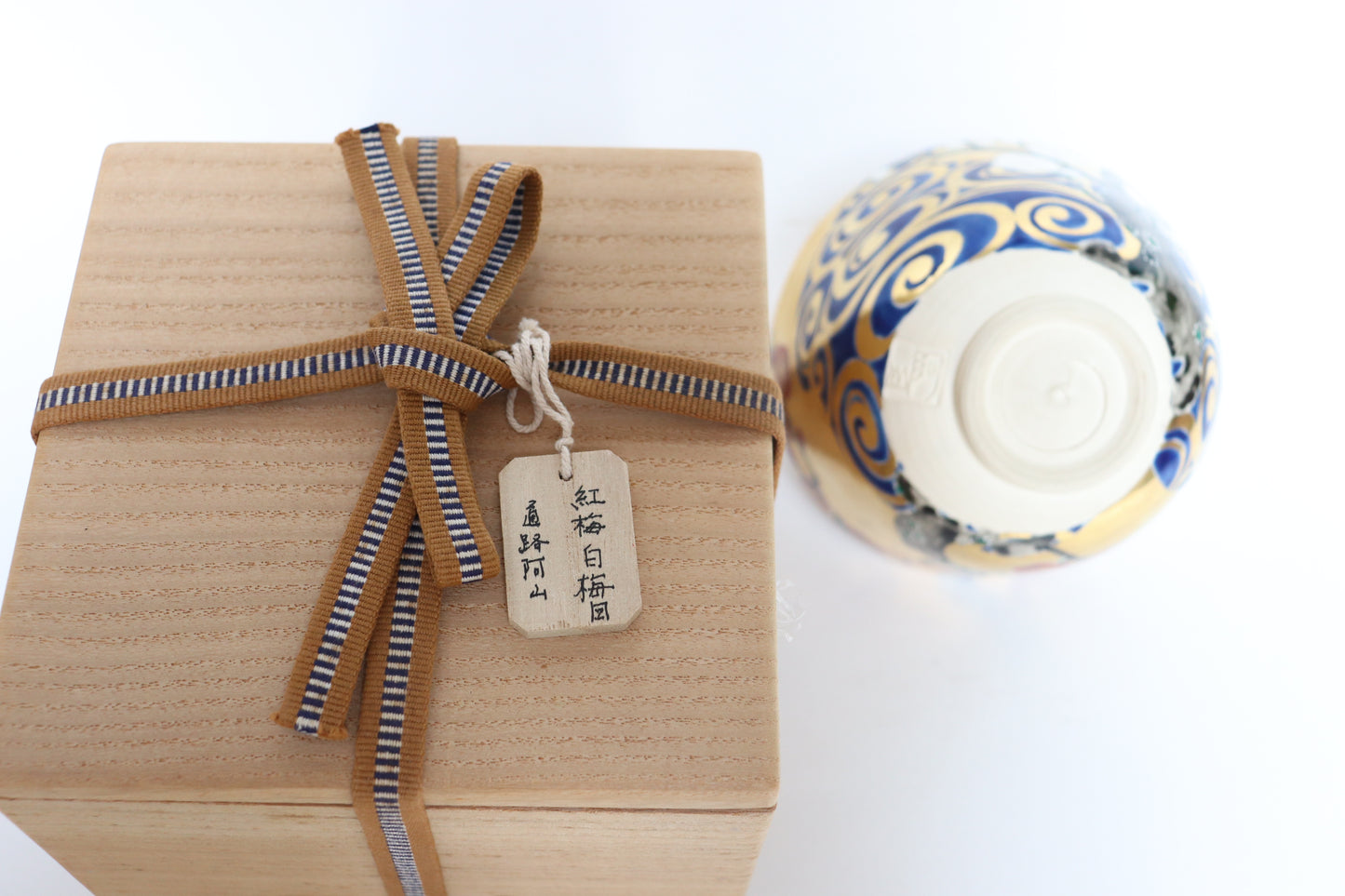


Bowl matcha red and white plum blossoms
Azan Tsuji — Kyoto
This bowl matcha This piece is a creation of ceramicist Azan Tsūji (通次阿山), one of Kyoto's most representative tea artisans, heir to the Kyō-yaki tradition while renewing it with a contemporary sensibility. Trained in the Kutani-yaki lineage, Azan Tsūji explores a wide range of techniques—polychrome enameling, gold over glaze, sometsuke, shōzui, and Raku—which he combines with a sense of rhythm and color characteristic of Kyoto. His work, refined yet free, is appreciated by tea masters for its balance between respect for tradition and decorative boldness.
This bowl is inspired by the famous Kōhaku-baizu (紅白梅図) motif, the "Red and White Plum Blossom Panel," a masterpiece by Ogata Kōrin (1658-1716), a major figure of the Rinpa school. In this monumental painting, two plum trees—one red, the other white—face each other across a stream of silver water against a gold background. The composition, with its subtle symmetry and striking contrast, embodies the essence of decorative refinement from the Edo period. It expresses the union of opposites: red and white, vitality and purity, life and peace.
On this bowl, Azan Tsūji translates this visual and symbolic dialogue into ceramic form. Red and white plum blossoms, delicately painted on an ivory glaze, echo each other through a fine, stylized river, rendered with silvery reflections. Accents of gold enhance the whole, evoking the brilliance of Kōrin's screen. This interplay of contrasts—light and shadow, movement and stillness—creates a soothing and poetic visual space, true to the spirit of tea.
The bowl matcha red and white plum blossoms Azan Tsūji's work perfectly illustrates his approach: to create a dialogue between the heritage of Rinpa and the modernity of Kyō-yaki, by offering the tea ceremony an object that is at once classic, sensual and profoundly Japanese.
Matcha Bowl Red and White Plum Blossoms
Azan Tsūji — Kyoto
This matcha bowl was crafted by Azan Tsūji, one of Kyoto’s leading tea ceramics artists, whose work bridges Kutani and Kyō-yaki traditions. While grounded in classical forms, Tsūji is known for his distinctly modern sensibility, integrating overglaze enamels, gold decoration, blue-and-white porcelain, and Raku techniques into a lively and elegant style that captivates tea practitioners and collectors alike.
The design is inspired by Kōhaku-baizu (Red and White Plum Blossoms), the celebrated folding screen painted by Ogata Kōrin in the early 18th century — considered his final masterpiece and a pinnacle of the Rinpa school. On a luminous gold ground, a stream of silver divides two opposing plum trees, one red and one white. The bold symmetry and interplay of colors convey both visual tension and harmony, representing the duality of vitality and serenity, passion and purity.
Azan Tsūji reinterprets this theme through ceramic expression. The red and white plum blossoms, finely rendered on a soft ivory glaze, face each other across a flowing silver stream. Touches of gold heighten the surface, recalling the brilliance of Kōrin’s original screen. The result is a composition of elegant contrasts — movement and stillness, brightness and shadow — that evokes the contemplative balance of the tea ceremony.
Azan Tsūji’s Red and White Plum Blossoms matcha bowl thus embodies his artistic ideal: to merge the timeless grace of Rinpa aesthetics with the living beauty of Kyoto ceramics, offering a vessel that unites classical refinement with contemporary vitality.