

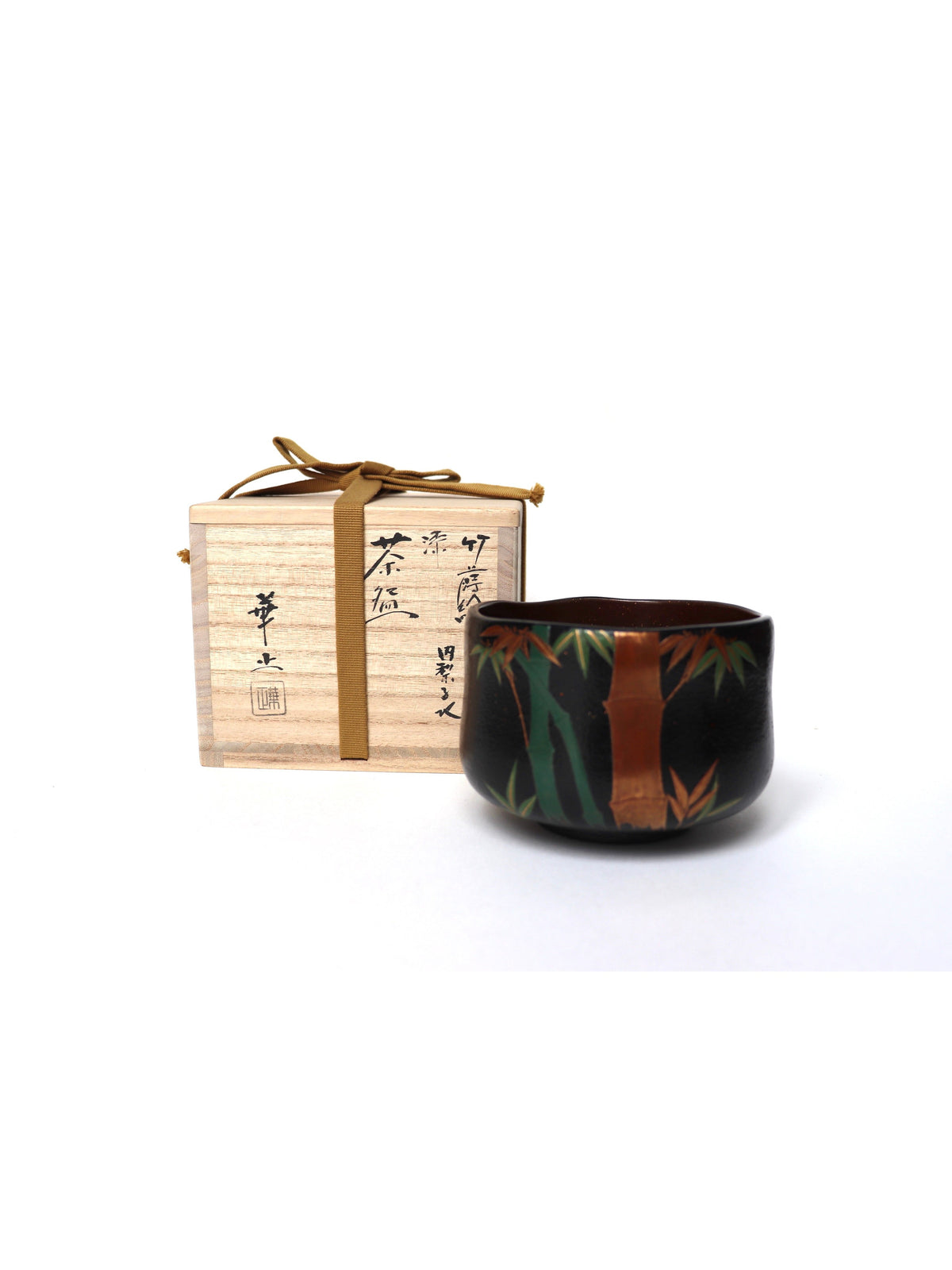
Lacquered wooden matcha bowl / "Také" in Yamanaka lacquer makié
Lacquered wooden matcha bowl / "Také" in Yamanaka lacquer makié
Quantity
Couldn't load pickup availability
Black lacquered wooden matcha bowl with makie bamboo pattern made by Kashô Yoshita (1940-), lacquer craftsman in Yamanaka, Ishikawa Prefecture.
Bamboo, an essential plant in Japanese life, is a highly auspicious symbol. Its upward growth, with rapid and vigorous expansion, represents nobility and strength. When cut, bamboo splits straight and hollow inside, signifying an honest nature with nothing to hide. This plant is also a symbol of purity, eternity, and immortality, as it remains green even under the snow during the cold winter.
Makie is a technique that involves painting a design, motif, or character onto the surface of a lacquered object using lacquer, then "sprinkle" (maku) it with gold, silver, or another metallic powder before it dries to fix it. It is one of the decorative techniques representative of Japanese lacquer, particularly developed and used in Japan.


Blog posts
-

New Year in the world of Japanese tea
Au Japon, on dit que le nouvel an du thé a lieu en novembre et non le 1er janvier. Cela s’explique par la saisonnalité des feuilles de thé et plus...
New Year in the world of Japanese tea
Au Japon, on dit que le nouvel an du thé a lieu en novembre et non le 1er janvier. Cela s’explique par la saisonnalité des feuilles de thé et plus...
-

Maintenance and cleaning of tea utensils and ac...
Our advice for maintaining your kyusu, your chasen and other tea utensils and accessories.
Maintenance and cleaning of tea utensils and ac...
Our advice for maintaining your kyusu, your chasen and other tea utensils and accessories.
-

The birth of the Maruyama Nori house in 1854 in...
The birth of the Maruyama Nori house in 1854 in the world historical context If we can imagine that 1854 was now almost 200 years ago, it can be...
The birth of the Maruyama Nori house in 1854 in...
The birth of the Maruyama Nori house in 1854 in the world historical context If we can imagine that 1854 was now almost 200 years ago, it can be...


